
Lekki Port Cargo Throughput 2026: Breaking Records
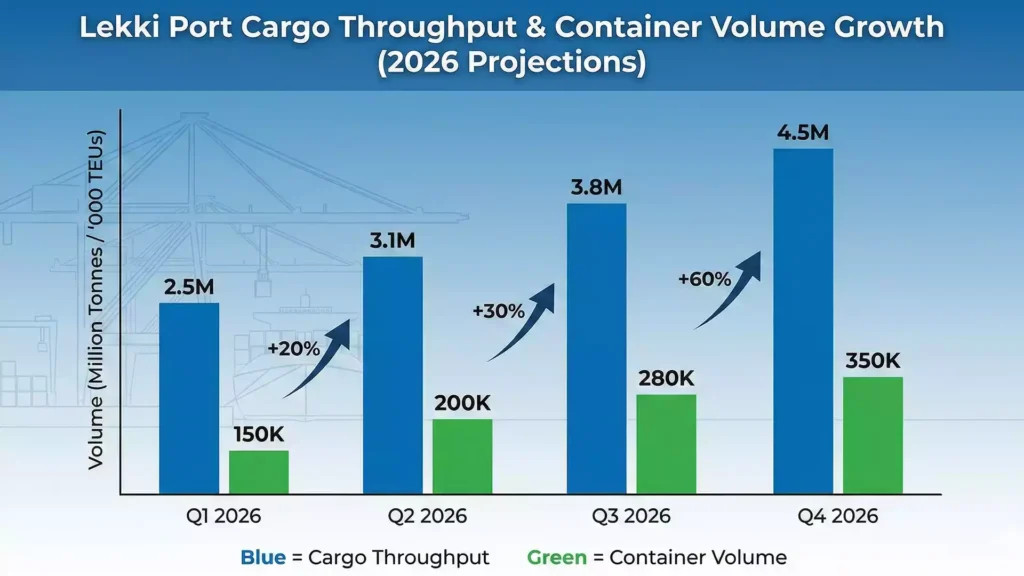
The Nigerian maritime landscape is currently experiencing a massive shift. Lekki Port cargo throughput 2026 has become a primary indicator of this rapid progress. Recent data from late 2025 and early 2026 reveals that the port has reached nearly 50% of its operational capacity. Consequently, this deep sea port is now the second-largest in Nigeria by trade value.
Importers and exporters are finally seeing relief from the chronic congestion at Apapa and Tin Can Island. The Lekki Deep Sea Port capacity allows for larger vessels to berth, which significantly lowers shipping costs per unit. Therefore, businesses are increasingly routing their shipments through this modern facility to save time and money.
Enhancing Nigeria Port Efficiency via Multimodal Solutions
Efficiency in logistics relies on more than just deep berths. It requires seamless connections to the hinterland. The surge in Lekki Port cargo throughput 2026 is supported by improved barge operations. Currently, barges move about 10% of the cargo from the port to other parts of Lagos. This alternative reduces pressure on the roads and speeds up delivery times.
At Flocargo (https://flocargo.com), we actively monitor these developments. We ensure our clients benefit from these faster evacuation corridors. Furthermore, the federal government is prioritizing the Lagos-Calabar Coastal Road. This project will eventually link the port to the eastern parts of the country. Thus, multimodal freight connectivity is slowly becoming a reality for Nigerian businesses.
Navigating the Future of Supply Chain Management
Smart logistics companies are already adapting to these changes. The increased Lekki Port cargo throughput 2026 demands faster customs processing and digital clearing systems. Flocargo’s sea freight services (https://flocargo.com/sea-freight) are optimized to navigate these modern terminals. We handle the paperwork so you can focus on growing your business.
Additionally, reports from the Nigerian Ports Authority suggest that automation is key to sustaining this growth. The port is fully automated, which minimizes human error and delays. This aligns perfectly with Flocargo’s commitment (https://www.google.com/search?q=https://flocargo.com/about-us) to transparent and reliable service.
Implications for Nigerian Trade and Commerce
The rise in volume is not just a statistic; it represents economic activity. Vanguard News highlights that the port handled over N13 trillion in trade value recently. This boom impacts everything from raw material imports to agricultural exports. Consequently, the need for professional customs clearing (https://flocargo.com/customs-clearing) is higher than ever.
To stay competitive, you must leverage these infrastructure upgrades. Lekki Port LFTZ Enterprise continues to push for rail integration to further boost capacity. Until then, relying on a logistics partner with strong road and barge networks is crucial. Flocargo’s logistics solutions (https://www.google.com/search?q=https://flocargo.com/services) provide that necessary bridge.
Strategic Steps for Importers
Do not get left behind by these industry shifts. The trend of rising Lekki Port cargo throughput 2026 is here to stay.
- Plan Ahead: diverse routes ensure stability.
- Use Experts: navigate new customs protocols easily.
- Stay Informed: track port updates regularly.
For more insights on how these changes affect your shipments, visit our blog. If you are ready to ship, contact us today for a quote. Leading sources like Business Day and The Punch agree that this is the dawn of a new maritime age.